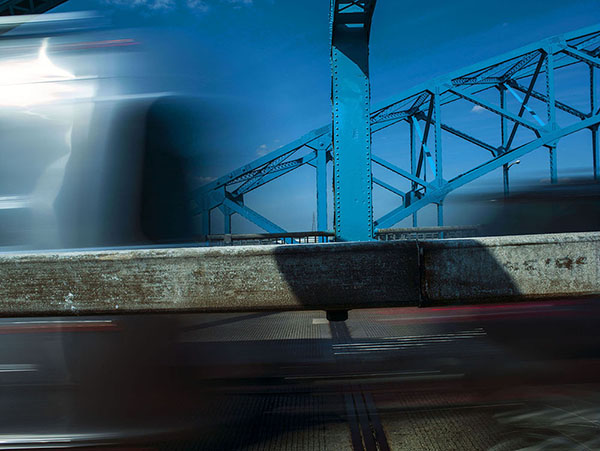
Road Fever, South Grand Island Bridge © 2013 Gunther Cartwright
Industrial Blues
photographs by Gunther Cartwright
Gunther Cartwright holds a Master of Fine Arts degree from the renowned Visual Studies Workshop in Rochester, New York. He is currently Professor Emeritus of Photographic Arts at the Rochester Institute of Technology, School of Photographic Arts and Sciences.
An active lecturer and exhibitor, Cartwright has made many presentations throughout Europe and the United States. He is a recipient of a Polaroid Corporation Photographer's Grant and a New York State Council on the Arts Public Service Grant. He has exhibited internationally in numerous one-man and group shows, including exhibitions at the Smithsonian Institution in Washington, D.C., the George Eastman House in Rochester, NY, the National Museum of Photography in Bradford, England, The Photographer's Gallery in London, England, and Photokina in Köln, Germany.
Cartwright presented a 55-print retrospective exhibition and was an Artist-in-Residence at Webster University. Coinciding with a major one-person exhibit at Ball State University, he presented lectures on his own work as well as illustrated lectures on the photographers of the Farm Security Administration (FSA) and on "Moments in Time" in photographic seeing. Recently Cartwright had 30 images on display the the Bausch and Lomb World Headquarters Building in Rochester, NY.
"The work, Industrial Blues, is not about a state of mind but rather a statement about color and form.
"Using the man-made environment and its resultant visual cacophony, Cartwright seeks out spaces and structures that one sees everyday, but perhaps does not record.
“The power lines, telephone poles, fences and industrial structure are a part of my daily visual experience. They are not in my way. I see them as elements of the landscape. They are there and they make their visual ‘sound.’ I am not interested in the picturesque but rather the formal arrangements of elements and color within the landscape.”
"By their framing, juxtaposition, and use of color, the resultant images are bright, bold transformations of what was in front of the camera. The images are often surreal and have a distorted sense of scale. With the strong use of color and an often close vantage point, Cartwright is able to bring interest and even beauty to the apparent chaos".
--- Alexandra Noble, Director,
The Photographers’ Gallery, London, England
INDUSTRIAL BLUES
"Gunther Cartwright's powerful images of the structural elements of bridges, buildings, highways, fences and storage containers examine the formal relationships of line, form and color in the industrial landscape. For Cartwright, the highly engineered equipment of our modern environment has become the subject of a bold and graphic aesthetic. Approaching his subjects as richly detailed arrangements, he emphasizes their forms through the skillful manipulation of scale and intense color. In the resulting juxtapositions of element against element and color against color, he suggests the sophisticated and often beautiful patterns of a manufactured world and rewrites them as a timely and incisive commentary on our culture. As he celebrates the signs and vistas of industrial creation and invention, he alludes to a modern alliance of man, machine and art. Like the American Precisionists of the 1920's Cartwright clarifies for us the geometrical structures of the machine age and provides us with a crisp new perspective of our Industrial Culture"
Georgette Lee, Exhibition Curator
Joseph and Emily Lowe Art Gallery
Syracuse University, Syracuse, New York
Over 30 prints from the Industrial Blues series were displayed at Through This Lens from March 16 through April 29, 2012. We continue to offer work by Mr. Cartwright - Please inquire about availability and pricing.
|

